
Ranking locally without a physical address might seem like a hurdle, but it’s entirely possible with the right strategies.
For service-area businesses (SABs), remote companies, or freelancers, mastering local SEO without a physical address opens doors to capturing local customers through Google’s local pack, organic search, and other channels.
This guide dives into actionable techniques, grounded in current best practices, to help businesses establish a strong local presence without a traditional storefront.
Doing Local SEO Without a Physical Address
Local SEO without a physical address hinges on leveraging Google’s tools, building localized authority, and optimizing for user intent.
Service-area businesses, such as plumbers, landscapers, or consultants, can rank in local search results by carefully configuring their Google Business Profile (GBP), building consistent citations, creating targeted location pages, and earning relevant backlinks.
The key is to signal to Google that the business serves specific geographic areas, even without a fixed office.
Here are the essential strategies to achieve this:
- Configure a Google Business Profile (GBP) with precise service areas.
- Build consistent citations across directories to reinforce local relevance.
- Create targeted location pages on the website for specific cities or regions.
- Earn relevant backlinks from local sources to boost authority.
Below, these essential strategies are broken down to make this achievable.
What Counts as a Physical Address in Google’s Eyes?
Google defines a physical address as a verifiable location where a business operates or meets customers. For traditional businesses like retail stores or restaurants, this is straightforward: a brick-and-mortar location. However, for SABs or remote businesses, the lack of a public-facing address complicates things.
Google’s guidelines explicitly state:
- PO boxes, virtual offices, or co-working spaces are not acceptable as primary business addresses.
- Home addresses can be used if the business owner is comfortable listing them, but they must be hidden from public view for SABs.
- Service areas can be defined in GBP to indicate where the business operates, replacing the need for a fixed address.
For businesses without a physical address, Google prioritizes signals like service area settings, consistent NAP (name, address, phone number) data across directories, and localized content to determine relevance.
Service-Area Businesses and Google Business Profile Policies
Service-area businesses operate differently from storefronts, as they travel to customers rather than hosting them at a fixed location. Google Business Profile is the cornerstone for SABs to establish local visibility.
To optimize a GBP without a physical address:
- Set up the profile as a service-area business: During GBP setup, select “I deliver goods and services to my customers” and define service areas by city, zip code, or region. Be precise, Google allows up to 20 service areas, so cover all relevant locations.
- Hide the address: If using a home or non-public address, ensure it’s not displayed publicly to comply with Google’s policies.
- Optimize the profile fully: Include a detailed business description, relevant categories (e.g., “Plumber” or “HVAC Contractor”), high-quality images of work, and regular posts to signal activity.
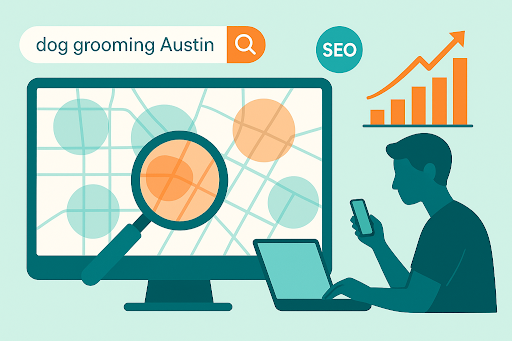
💡 A real-world example: A mobile dog grooming business in Austin, Texas, can set its GBP to cover specific zip codes like 78701 and 78703, add “dog grooming” as the primary category, and post weekly updates about pet care tips. This approach signals relevance to local searchers without needing a storefront.
Alternative Strategies for Local Visibility
Without a physical address, businesses must rely on alternative signals to build local authority. These strategies amplify visibility in local search results and reinforce trust with Google and users.
Consistent Citations Across the Web
Citations, mentions of a business’s NAP on directories like Angi, Manta, or Thumbtack, are critical for local SEO.
For businesses without a physical address, consistency is key:
- Use the same business name and phone number across all listings.
- For the address field, use “Service Area” or list the primary city served (e.g., “Serving Seattle, WA”).
- Focus on niche directories relevant to the industry, such as Houzz for home improvement services or Avvo for legal professionals.
Tools like BrightLocal or Moz Local can streamline citation building and ensure consistency. A 2023 study by BrightLocal found that businesses with consistent citations across 50+ directories ranked 20% higher in local pack results than those with inconsistent data.
Location Pages on the Website

Creating dedicated location pages on the business website is a powerful way to rank for local keywords. Each page should target a specific city or region that the business serves. For example, a house cleaning service might create pages like “House Cleaning in Denver” or “Maid Services in Boulder.”
Best practices include:
- Unique, high-quality content (300–500 words per page) tailored to the location.
- Embedding a Google Map with the service area pinned (not a specific address).
- Including customer testimonials or case studies from the area.
- Optimizing on-page elements like title tags, meta descriptions, and headers with location-specific keywords.
These pages signal to Google that the business is relevant to specific geographies, boosting organic rankings. For expert help in crafting these pages, businesses can explore professional SEO services.
Localized Content and Blogging
Content that speaks to local audiences builds authority and engagement. For instance, a roofing contractor could write blog posts like “How to Prepare Your Chicago Home for Winter Roof Repairs” or “Top 5 Roofing Issues in Phoenix Homes.”
These posts should incorporate local keywords naturally and address pain points specific to the area, such as weather patterns or regional regulations.
Building Local Authority Through Backlinks and Content
Backlinks from reputable local sources signal to Google that the business is trusted within its community.
Strategies to earn local backlinks include:
- Partnering with local organizations, such as sponsoring a community event or writing a guest post for a local blog.
- Getting listed in local business associations or chambers of commerce websites.
- Earning mentions from local news outlets by sharing expertise (e.g., a landscaper commenting on drought-resistant plants for a regional publication).
💡 A pro tip from seasoned SEO strategists: Focus on intent-focused content to dominate local packs. For example, create content that answers hyper-specific local queries, like “emergency plumber near me” or “same-day HVAC repair in [city].”
Pair this with schema markup (e.g., LocalBusiness schema) to enhance Google’s understanding of the business’s service areas. This tactic often outperforms generic content in local pack rankings.
Avoiding Common Missteps

Businesses without a physical address often fall into traps that can harm their local SEO efforts.
Key pitfalls to avoid:
- Faking an address: Using a virtual office or fake address violates Google’s guidelines and risks profile suspension.
- Using a P.O. box: Google explicitly prohibits P.O. boxes as business addresses.
- Overstuffing service areas: Listing too many irrelevant cities in GBP can dilute relevance and confuse Google’s algorithms.
- Neglecting reviews: Failing to encourage and respond to Google reviews can weaken trust signals. Aim for 10+ reviews with a 4.5+ star rating for optimal impact.
A common misconception is that local SEO is impossible without a physical address. This is false! Google’s algorithms prioritize relevance, proximity, and prominence, not just a physical location. By focusing on service areas, citations, and localized content, businesses can compete effectively.
Taking the Next Steps for Local Success
Establishing a strong local presence without a physical address is not only achievable but also a competitive advantage for agile businesses.
Start by optimizing the Google Business Profile with precise service areas and a robust business description. Build consistent citations across industry-specific and local directories. Create location pages and intent-focused content to capture organic traffic. Finally, pursue local backlinks to solidify authority.
For businesses seeking faster results or facing complex challenges, partnering with a digital marketing agency can provide tailored strategies. To dive deeper into advanced local SEO tactics, contact SEO experts for a customized plan. With the right approach, any business can thrive in local search – no storefront required.